Setup
Definition:
Symmetric simultaneous-move game with full-support and support-restricted mixing
- Players: Two players, Player 1 and Player 2.
- Strategies: Each player chooses , , or .
Rules
- Start with a symmetric payoff matrix; Players simultaneously choose pure strategies or mix over supports.
- The player who makes the opponent indifferent over the relevant support reaches mixed equilibrium.
- Players move simultaneously.
- Diagonal outcomes give payoffs , , and at , , and ; The off-diagonal entries below are a compact formalisation consistent with the visible support-analysis results in the lecture notes.
Payoff Matrix
| A | B | C | |
|---|---|---|---|
| A | 1, 1 | 1, 0 | 0, 0 |
| B | 0, 1 | 2, 2 | 1, 0 |
| C | 0, 0 | 0, 1 | 3, 3 |
Derivation (Best Response Analysis)
- Against , Player 1 compares , so .
- Against , Player 1 compares , so .
- Against , Player 1 compares , so .
- By symmetry, , , and .
- Let Player 2 mix with probabilities on . Then Player 1’s expected payoffs are:
- Pairwise indifference boundaries are:
- Hence, for and ,
- By symmetry, if Player 1 mixes with , then Player 2’s expected payoffs are:
- Hence, for and ,
Diagram (Best Response Regions)
- Each graph uses the first two probabilities on the axes. The probability on is the residual term.
\centering
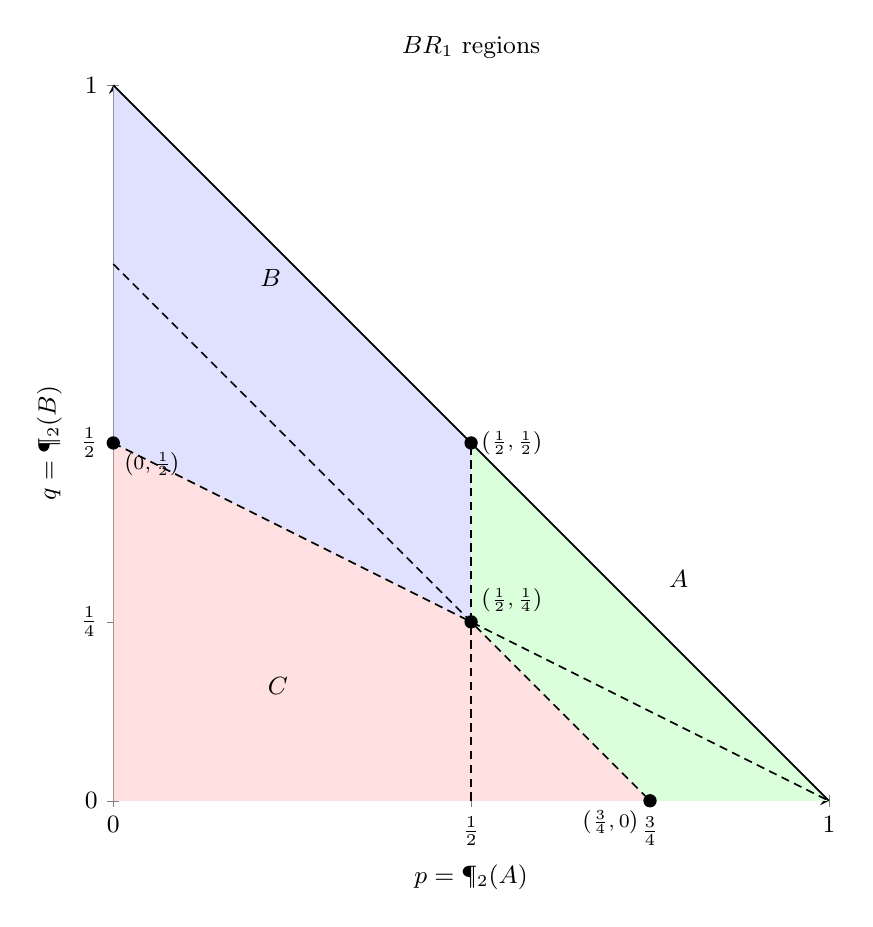
\centering
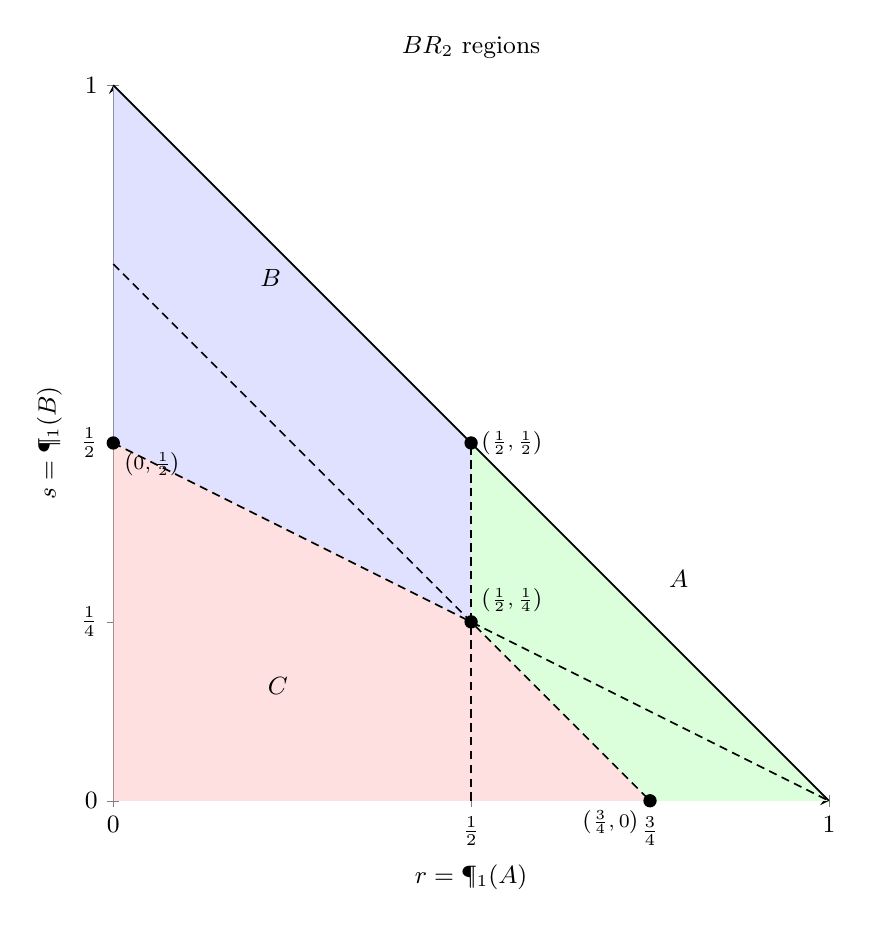
Derivation (Nash Equilibrium)
- Pure mutual best responses give
- For support , set the probability on equal to and impose
- This gives
- Since on this support,
- Check the omitted action:
- For support , set the probability on equal to and impose
- Since on this support, this gives
- Check the omitted action:
- For support , set the probability on equal to and impose
- Since on this support, this gives
- Check the omitted action:
- For a fully mixed equilibrium, impose
- Solving gives
- By symmetry, Player 1 uses the same probability vector in each mixed equilibrium.
Nash Equilibrium
Result:
The game has seven symmetric Nash equilibria:
- pure equilibria:
- two-action mixed equilibria:
- a fully mixed equilibrium:
with strategy order for both players.
Social Optimum
- Total payoff at is .
- Total payoff at is .
- Total payoff at is .
- Every off-diagonal outcome gives total payoff or .
- Therefore is the unique social optimum.
Insights
Insight:
- The new matrix supports one symmetric equilibrium for every nonempty support subset of .
- Support restrictions change the indifference equations, so each two-action support generates a different mixed equilibrium.
- The Pareto-dominant equilibrium is also the unique social optimum.